
Imagine a familiar situation for a DeFi user in Germany. You hold USDC on Arbitrum, discover a promising lending market on Base, and want to move funds through a bridge before depositing them. The operation may involve several contracts, a network change, a token approval and more than one fee. In a conventional wallet, the decisive question is often reduced to: “Do you want to sign?” That is a poor question. The more useful question is: “What will this signature cause?”
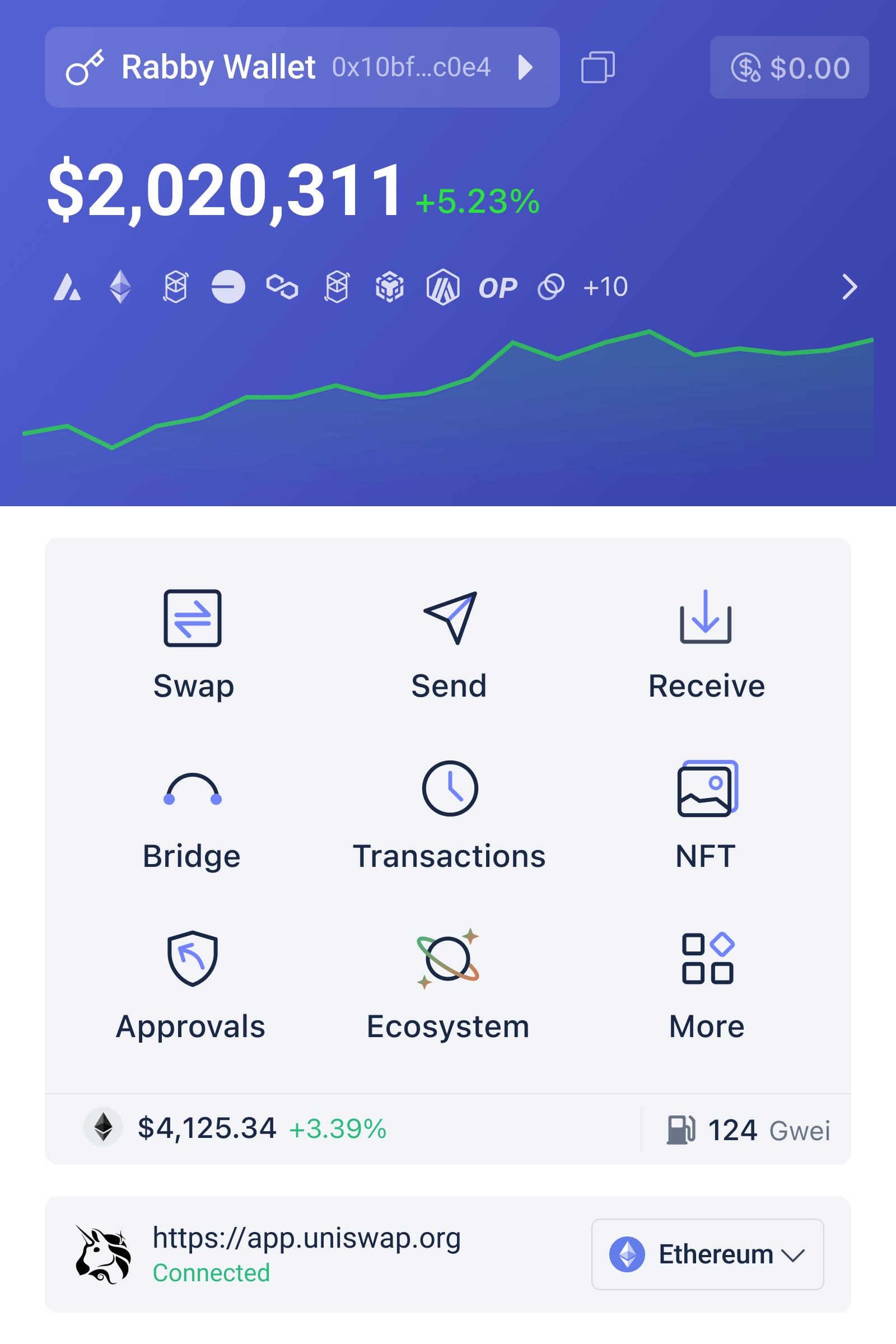
This is the practical problem addressed by Rabby Wallet. Its role is not simply to store keys or display balances, but to make a complex EVM transaction more intelligible before approval. The wallet combines broad network coverage, automatic chain switching, contract warnings and transaction simulation. None of these features makes DeFi risk-free. Their value lies in moving some risk detection earlier, when a user can still cancel rather than after an irreversible on-chain action.
Why a multi-chain wallet needs more than a chain selector
Ethereum-compatible networks share a common programming environment, but they do not create one unified market. Ethereum, Polygon, Arbitrum, Optimism, Avalanche, Base and the BNB Chain have different liquidity, fee conditions, bridge routes, applications and operational assumptions. A wallet that supports more than 140 EVM-compatible networks can reduce the friction of moving between them, but network count alone is not the important metric. The real test is whether the interface helps the user understand which chain an application is using and what assets are actually available there.
Rabby is designed around this multi-chain reality. When a decentralised application, or dApp, requests a particular network, the wallet can detect the requirement and switch to it automatically. That sounds like a small convenience. In practice, it addresses a recurring source of error: a user may believe they are interacting with the same application and asset while the wallet is connected to another chain. Automatic switching reduces manual mistakes, although it should not replace checking the network shown in the transaction review.
The wallet also integrates cross-chain routes through services such as LI.FI, and provides a swap aggregator that can compare routes involving decentralised exchanges such as Uniswap and 1inch. This creates a smoother experience than opening several applications separately. It also concentrates more decision-making inside one interface. That is efficient, but it means users should still inspect the route, fees, expected output and bridge counterparties rather than treating an aggregated quote as a guarantee of the best economic result.
For readers evaluating a rabby wallet extension, the useful distinction is between navigation and custody. Rabby is non-custodial: private keys are stored locally on the user’s device and are not sent to Rabby’s servers. The wallet does not take possession of funds or independently create transactions on the user’s behalf. It prepares and displays signing information, while the user or connected hardware wallet authorises the action.
Transaction simulation is a preview, not a crystal ball
The most educational Rabby feature is transaction simulation. Before signing, the wallet runs a representation of the proposed call and shows expected changes to token balances. Instead of seeing only a contract address and an opaque data field, the user may see that USDC is expected to leave the wallet, another token should arrive, and an approval may grant a contract permission to spend assets later.
This changes the mental model of a wallet. A signature is not merely proof of identity. In many DeFi interactions, it is an authorisation for a smart contract to alter balances according to programmed rules. Simulation makes those consequences more visible. It can therefore catch a pasted phishing link, an unexpected token transfer, a suspicious approval or an incorrect network before the private key is used.
There is an important technical boundary, however. A simulation is an estimate based on a particular blockchain state and the assumptions of the simulation environment. Between simulation and mining, prices can move, liquidity can change, a block can be reordered, or another user can consume the available opportunity. A bridge may also depend on off-chain services or later settlement steps that are not fully represented by a simple balance preview. Simulation improves visibility; it does not provide finality, insurance or a guarantee against loss.
The same caution applies to signed messages that do not look like ordinary token transfers. Permit-style approvals, marketplace orders and other off-chain signatures can authorise future actions without immediately changing a visible balance. A strong review process therefore asks not only, “What changes now?” but also, “What authority am I granting?” Rabby’s security engine can flag risks including phishing indicators, known exploits and potentially unlimited token approvals, yet users should treat warnings as evidence to investigate, not as a substitute for understanding the application.
Security architecture: useful separation, incomplete protection
Rabby’s design combines several layers that address different failure modes. Local key storage limits the damage from a compromised wallet provider, while hardware-wallet compatibility with Ledger, Trezor and OneKey adds a separate signing boundary. The open-source MIT-licensed codebase allows independent review, which is valuable for transparency. A scanner can examine addresses and contracts, and simulation can reveal expected balance changes. These protections are complementary rather than interchangeable.
That distinction matters because crypto security is often described as if one feature could solve the whole problem. A hardware wallet can protect a private key from many forms of malware, but it cannot make a malicious transaction economically safe if the owner approves it. Open-source code can be inspected, but reviewability does not prove that every release, dependency or browser environment is harmless. Local storage reduces custodial exposure, but the user’s computer, recovery phrase and browser remain part of the security boundary.
There is also a difference between backend independence and information independence. Rabby’s core signing functions can remain usable if Rabby’s own servers are unavailable, because the wallet does not need the provider to take custody of keys or create transactions. In contrast, simulations, risk labels, token metadata and route quotations depend on access to blockchain data and external services. A server outage may therefore reduce the quality of warnings or previews even if signing itself remains possible. This is a strength with a boundary, not an absolute guarantee of uninterrupted functionality.
Where Rabby fits against alternatives
MetaMask remains a broad, familiar entry point for Ethereum and EVM applications. Its advantage is recognition and a large ecosystem of integrations. Rabby’s differentiation is more specific: it is built around multi-chain DeFi workflows, automatic network handling and richer pre-signing risk information. For someone who mainly uses one established application, the difference may be modest. For a user regularly moving between Ethereum, rollups, sidechains and bridges, the reduced context switching can be more consequential.
A hardware wallet is not necessarily a competing choice. It is better understood as a signing layer that can be used with Rabby or another interface. Its strongest trade-off is security against online key exposure in exchange for extra setup and less convenience. A user who holds significant value may reasonably use Rabby for readable transaction analysis while requiring a Ledger, Trezor or OneKey device for final authorisation.
A multisignature wallet such as a Safe serves a different purpose. It distributes control across several signers and is well suited to treasuries, teams and higher-value operational accounts. It can reduce single-key risk, but it introduces coordination costs and is not always the fastest tool for an individual swapping or supplying liquidity. The choice is therefore not “which wallet is safest?” in the abstract. It is “which failure mode matters most for this account?”
A practical review framework for German DeFi users
Before confirming a transaction, separate the review into four questions. First, identity: is the website, contract and wallet address the one you intended to use? Second, authority: is this a one-time transfer, a limited approval or an open-ended permission? Third, economics: what are the expected assets received, fees, slippage and bridge costs? Fourth, reversibility: if the transaction succeeds but the outcome is poor, can anything be undone? Blockchain settlement usually makes the final question uncomfortable, which is precisely why it should be asked early.
Features such as Gas Account can reduce another practical obstacle. Paying network fees with a stablecoin such as USDC may help when a user has funds on a chain but lacks its native gas token. That can make multi-chain activity more accessible, especially during a first interaction with a new network. It also adds a service and routing dependency, so the user should check the applicable cost and the exact asset being used rather than assuming that fee abstraction is free.
Rabby Points, earned through activities such as swaps, gas top-ups or referrals, may make the product more engaging. But loyalty incentives should remain separate from security judgment. Points can influence interface behaviour or encourage activity; they cannot improve contract quality, bridge solvency or transaction settlement. For a serious DeFi workflow, the order of priorities should remain risk comprehension, key protection and operational discipline.
What to watch as wallets become decision tools
Recent Rabby positioning presents the product as a general-purpose wallet for Ethereum and EVM activity across Chrome, Brave and Edge, with desktop and mobile availability as well. The more significant direction is not a particular slogan but the broader shift from wallets as passive key containers toward wallets as transaction interpretation layers. If simulations, approval analysis and route comparison become more accurate and easier to audit, users may make fewer blind approvals.
That outcome is conditional. It depends on reliable data sources, clear presentation and users who pause when a result looks unfamiliar. The next meaningful benchmark is therefore not how many networks a wallet lists, but how well it communicates uncertainty: whether it distinguishes a confident balance prediction from a fragile route estimate, explains an approval’s scope and makes unusual contract behaviour visible. In that sense, the best multi-chain wallet is not the one that hides complexity most effectively. It is the one that removes unnecessary complexity while exposing the complexity that can cost money.
Frequently asked questions
Does Rabby transaction simulation guarantee that a transaction is safe?
No. Simulation shows expected effects under a particular blockchain state and can reveal many suspicious outcomes, but it cannot guarantee protection against changing prices, block ordering, compromised websites, off-chain settlement risks or every form of malicious code. Users should still verify the domain, contract, approval scope and economic terms.
Is Rabby suitable for all crypto networks?
Rabby is focused on EVM-compatible networks and supports a wide range of them, including Ethereum, Polygon, Arbitrum, Optimism, Avalanche, Base and BNB Chain. It is not a universal wallet for every blockchain architecture. Users active on non-EVM networks may need a separate wallet designed for those ecosystems.
Can Rabby replace a hardware wallet?
It can provide a strong interface for reviewing transactions, but it does not replace the additional key isolation offered by a hardware wallet. For larger balances, combining Rabby’s simulation and warnings with a Ledger, Trezor or OneKey signing device can provide a more robust division of responsibilities.